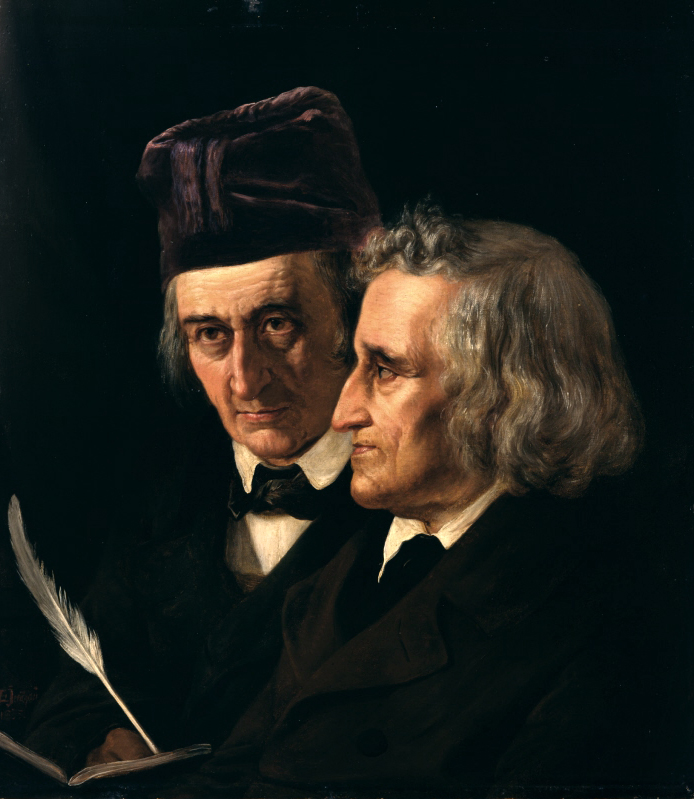
Zoya and I spent a pleasant hour at the used bookstore the other day shopping for classic children's literature, the rare 5 or 6 copies there that are not abridged or an altered version of the original. My most exciting find was a copy of Grimm's Fairy Tales. (On Zoya's end, she found a copy of a Richard Scarry board book. :) I read with great interest the story of the Brothers Grimm in the introduction to this particular copy. I had no idea that they intended this collection as a documentation of German folklore throughout history. I was under the mistaken impression that they had imagined these themselves.
Unlike Anderson, the Grimms did not invent new tales but collected old ones, with the intention of preserving the oral tradition of the German peasantry. Whether or not they fulfilled that intention has been questioned... Beginning this work as both a study of the German language and an attempt to document the customs of the German people, the brothers collected their folktales by mining a variety of sources, including peasants and lower-class people, nannies and servants, educated young women from upper-middle-class and aristocratic families, and accounts in books and magazines. Grimm's Fairy Tales, notes by Elizabeth Dalton.In time, the stories were noted for their common motifs which arise cross culturally throughout the ages. Also, the graphic nature of the stories met with resistance and pressure to clean them up as children became the popular audience, which they themselves had little interest in doing ("the innocence...of a straightforward narrative that does not conceal anything wrong by holding back on it") yet ultimately accommodated (who knew that Rapunzel noticed her clothes getting tighter at one point?).
I delved in last night with "The Frog Prince," anxious to see how graphic and lurid these tales can be. You know the story, right? A young maiden finds a frog and gets talked into kissing him out of her great compassion. Turns out, he's a prince who transforms back into human form so they can live happily ever after.
Wrong I was. I've always found simultaneous chagrin and enjoyment, as I have written before, in observing the changes that happen to literature as it gets "re-presented," so to speak, to the modern day. In the Grimm brothers' version, the young girl plays near a cool stream with a golden ball. This was her "favorite amusement...when she felt dull," except this time, the ball rolls away into a fountain. She laments loudly, at which point a very ugly frog appears and begins talking with her. She promises him her companionship, table, and bed in exchange for her ball. She promises it all while inwardly planning that he will "remain in the water with his equals."
He fetches the ball; she leaves him there. Day after day the frog arrives at the door of the castle and she gets so disturbed that she ultimately tells her father about their exchange. He holds her to her word. She reluctantly invites the frog to dinner and then into her room where she presumes he will sleep in the corner. The frog begins pressuring her to "take [him] up." She becomes so disgusted that she "[throws] him with all her strength against the wall." He transforms into a handsome prince at which point they develop a deep friendship and then love for one another.
There are so many interesting and rich elements to this version: her scheming personality and reluctant obedience, the pressure from her father and the frog, and their ultimate success in establishing a relationship. Apparently, the frog prince's former butler was so loyal that he had bound his heart in metal bands when his former master had been turned into a toad, so as the prince and the princess are driving away with him, they hear the snapping sounds of the bands breaking on "trusty Henry's" heart. I love the way she throws the frog with all her might.
This is a far cry from the pitying young woman who kisses the poor amphibian by the lakeside, as though a maiden can only be compassionate when attending to the sexual needs of something (even a frog's). Interestingly, a second translation of Grimm presents a much different story: she permits the frog to sleep with her three nights in a row, at which point she wakes up to find a prince gazing upon her. No frog slaughter at all.
When I read this version, I see a redemptive story here for both the young man and woman (this could just be my worldview shining through...smile). Their individual characters are the main focus of the story~~their inner motivations and shortcomings. I can hear all my former complaints about the patriarchal structures in place here which render her helpless to make her own decisions. She is forced to choose her follow-through by her father and will certainly not make idle promises in the future that she doesn't intend to keep.
This kind of thing would have driven me crazy in the past. I have found myself relaxing when I encounter these controlling family structures in literature. It is reasonable for a father to encourage his daughter to take her oaths seriously. It is reality, on the other hand, that fathers and men have forced daughters and women to do all sorts of things until relatively recently in history and in only certain places. (I am thinking of a recent article from Pakistan in which several girls were shot and buried alive for wanting to choose their husbands.)
Just because it's there doesn't make it a promotion. Removing these elements is like trying to remove the reality. Removing Rapunzel's tightening clothes from the story removes the humanity, the consequences, the sexuality, the temptation, or however else you want to look at it, for better or for worse. We all have our interpretations but keeping Rapunzel's true life invisible does not permit anyone to see her wholly.
Reading "Snow White" later that night left me with the feeling that the evil stepmother has its guaranteed place in the Disney movie but at the expense of the inner process of the "heroine," if you can call her that. Snow White is severely gullible to a fault. She gets duped again and again in spite of the excellent advice she receives from the Dwarfs. In these two stories, the world revolves around the outer beauty of the maiden, yet the narration centers on her inner process, which may, indeed, turn out to fail. She rather arbitrarily survives her own incredible stupidity. And it is not, in fact, because she is saved by the kiss of a prince. Far from it. How in the heck did Snow White ever qualify as a Disney Princess?
I think it will be easier to teach my daughters (God help me!) to be "shrewd as serpents and innocent as doves" (Matthew 10:16) with Grimm's version rather than Disney's. The Grimm brothers hash out her character flaws rather well. It will also be interesting to talk to Wolfgang and Psalm about just what this prince had to do to become an ugly and imprisoned toad. Have you noticed how the male characters in the Disney reenactment are perfect and lovely? All they need to do is show up and "kiss the girl" and they do their job. I love how "trusty Henry" attests to a serious fall on behalf of his master who led to his state of degredation.
Just food for thought...would love to hear your take on reading Grimm with children.

No comments:
Post a Comment